
Common Applications of Sintered Bronze Mufflers and Silencers in Industrial Equipment
Common Applications of Sintered Bronze Mufflers and Silencers in Industrial Equipment
In pneumatic and industrial equipment, exhaust noise is often treated as a small detail until it becomes a daily operating problem. A machine may work well, but the discharge sound is sharp, repetitive, and disruptive. In other cases, the issue is not only noise. Fast exhaust flow can carry dust, oil mist, or small debris, while poorly matched mufflers may clog quickly or create unwanted backpressure. This is where sintered bronze mufflers and silencers are commonly used.
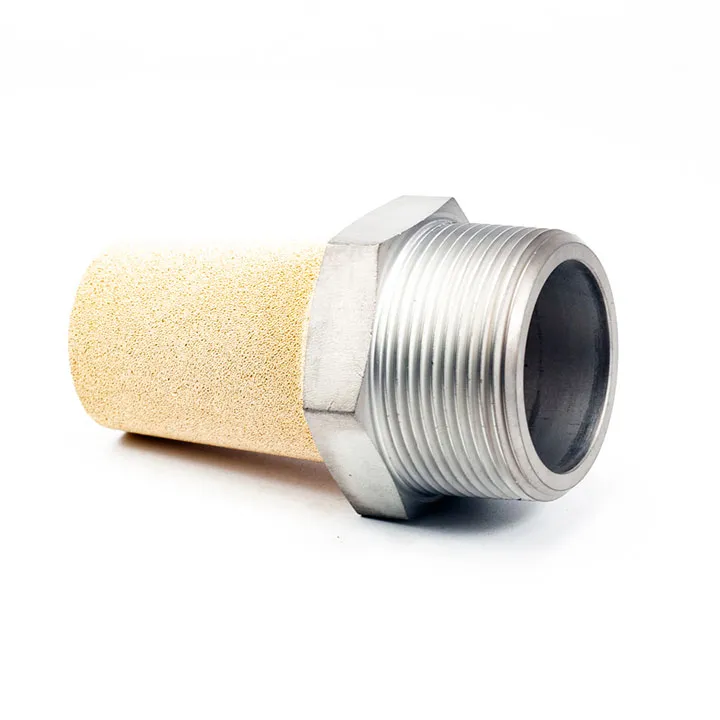
A sintered bronze muffler is a porous metal component installed at an exhaust or venting point to help diffuse flow, reduce harsh discharge noise, and provide a degree of coarse particulate control in the outgoing air path. It is widely used in pneumatic automation, compressed air systems, valves, cylinders, regulators, and general machinery because it offers a practical balance of durability, stable porous structure, compact size, and cost-effectiveness.
However, many buyers still look at these parts too narrowly. They think of them only as simple accessories or interchangeable fittings. In reality, the right bronze silencer element can influence machine noise characteristics, exhaust behavior, contamination management, maintenance frequency, and installation fit. The wrong choice can lead to unstable performance, faster clogging, and repeated replacement headaches.
This article explains the common applications of sintered bronze mufflers and silencers, where they are most useful, why they are selected in specific systems, what common mistakes buyers make, and how a component such as BRONZE FILTER 36X42X50 80MICRON may fit practical industrial applications.
What Is a Sintered Bronze Muffler?
A sintered bronze muffler is a porous metal exhaust component made by pressing bronze powder into shape and then sintering it so that the particles bond together while leaving an interconnected pore network. Unlike a simple drilled vent or a plain open fitting, the bronze muffler diffuses the outgoing air through many small passages inside the porous structure.
This matters because the exhaust stream is no longer released as one concentrated blast. Instead, it is distributed through the porous material, which can soften the discharge effect and help reduce the sharpness of the sound. At the same time, the rigid porous structure makes the part suitable for repeated industrial use in compact assemblies.
In practical terms, a bronze silencer element is often chosen when a system needs:
more controlled exhaust diffusion,
a compact metal muffling component,
stable installation geometry,
and a practical solution for general pneumatic service.
It is not a magic noise-killing device, and it should not be sold that way. It is a functional porous metal part that improves exhaust behavior in the right application.
Why Sintered Bronze Is Commonly Used for Mufflers
There are several reasons bronze remains a common muffler material in industrial equipment.
First, it can be produced as a rigid self-supporting porous part. That makes it suitable for threaded fittings, inserts, and compact muffler bodies used in automation equipment.
Second, its porous structure is well suited for airflow diffusion. In exhaust service, this helps change the discharge pattern from a direct high-speed jet into a more distributed release.
Third, bronze mufflers are widely accepted in general pneumatic applications because they are practical and economical for many systems that do not require more expensive materials.
Fourth, sintered bronze mufflers are available in a wide range of dimensions and pore structures, which makes them useful when equipment designers need to match connection size, installation space, and desired exhaust behavior.
In short, bronze works well because it is not trying to be everything. It is trying to be a dependable porous muffler material for standard industrial use, and in many cases that is exactly what the application needs.
What a Muffler Actually Does in a Pneumatic System
To understand the applications, it helps to first understand the job.
A sintered bronze muffler is typically installed at the exhaust port of a pneumatic valve, actuator, or air-handling component. Its main role is to diffuse outgoing compressed air so that the discharge is less abrupt and less noisy than an open exhaust port.
Depending on the system, it may also help:
reduce the harshness of exhaust discharge,
limit the direct release of larger particles or oil mist droplets,
protect the port opening from external debris entry in idle conditions,
and provide a more controlled exhaust profile.
This is why mufflers are widely used in factory automation, workshop machinery, packaging lines, and process support equipment. Compressed air systems are efficient, but they are not quiet by default. Left alone, they can be annoyingly expressive — like coworkers who answer every small problem with maximum volume.
Common Applications of Sintered Bronze Mufflers and Silencers
1. Pneumatic Valves
One of the most common applications is on pneumatic control valves. Solenoid valves, directional valves, and manually operated valves often release compressed air during switching or operation. Without a muffler, that exhaust can be sharp and noisy, especially in equipment that cycles frequently.
A sintered bronze muffler installed on the valve exhaust port helps spread the outgoing air through the porous structure, which can reduce the harsh discharge effect and create a more controlled exhaust pattern. In equipment with repeated actuation, this is often one of the simplest and most common ways to improve working noise conditions.
For automation equipment manufacturers, this application is especially important because valve exhaust noise is often a recurring complaint once machines are installed on the production floor.
2. Pneumatic Cylinders and Actuators
Pneumatic cylinders and actuators are another major application area. When air is exhausted from these devices, the discharge can be sudden, repetitive, and disruptive, particularly in machines with fast cycle times.
Bronze silencers are often used to moderate the exhaust behavior of these systems. In some cases, the goal is worker comfort. In others, it is equipment presentation, especially when the machine operates near staff, customers, or inspection stations where repeated sharp exhaust noise creates a poor impression.
Here the bronze muffler is not just an accessory. It becomes part of how the machine feels in real operation. Buyers often focus on speed, output, and control logic during design, then discover later that the machine sounds like it is constantly arguing with itself. A muffler helps bring some discipline to that conversation.
3. Air Tools and Workshop Equipment
Certain pneumatic tools and workshop devices also use sintered bronze mufflers or porous silencer elements to manage exhaust discharge. Air-driven devices can release compressed air in bursts, and controlling that exhaust can improve usability in work areas where multiple tools are used repeatedly.
In these settings, the main value is often practical rather than technical elegance. The muffler helps make the equipment less harsh in day-to-day use and may also support more controlled exhaust discharge near the operator.
4. Regulators, Flow Control Devices, and Pneumatic Assemblies
Bronze silencers are also commonly found in regulators, small pneumatic manifolds, air preparation devices, and other compact assemblies. In these systems, space is often limited, and the silencer must fit a defined connection size or body shape.
This is one reason dimensional matching matters so much. A buyer may fully accept the idea of using a muffler, but if the installation dimensions do not align with the equipment layout, the part becomes useless no matter how good the material is.
For this reason, products such as BRONZE FILTER 36X42X50 80MICRON can be relevant not only because of material and pore structure, but because the physical size may suit specific assembly requirements.
5. Automated Packaging and Production Equipment
Packaging machinery, assembly systems, indexing equipment, and other automated production machines commonly use compressed air. These machines often have multiple valves and pneumatic actuators operating in repeated cycles, which creates a cumulative exhaust noise issue.
In such systems, sintered bronze mufflers are used to make exhaust behavior more manageable across the machine. A single exhaust point may not seem significant on its own, but a whole machine with repeated unmoderated discharge can create a tiring acoustic environment.
This is where automation equipment manufacturers often become practical very quickly. What seems like a small fitting on the drawing becomes a clear usability issue when the machine runs all day.
6. Instrument and Control Equipment
In some control systems and instrument-related equipment, bronze mufflers are used on venting or low-flow exhaust points where compact size and stable porous structure are important. The role here is usually not large-scale sound control, but local exhaust moderation and controlled venting behavior.
These applications may also require attention to cleanliness and port protection, especially if the equipment is installed in environments where airborne dust or debris could affect exposed openings.
7. General Industrial Machinery
Beyond dedicated pneumatic equipment, sintered bronze mufflers appear in a wide range of general machinery that uses compressed air or venting functions. This can include textile equipment, workshop machines, maintenance systems, robotic fixtures, assembly stations, and OEM-built devices.
The exact application varies, but the logic is usually similar:
there is an exhaust point,
the open discharge is too harsh or uncontrolled,
space is limited,
and a compact porous metal muffler is a practical solution.
Why Buyers Choose Bronze Silencer Elements
Stable Porous Structure
A sintered bronze muffler has a fixed porous structure formed during manufacturing. This allows it to function as a rigid metal component rather than a soft insert or disposable noise-control medium.
Compact Installation
Bronze mufflers are often used where space is limited and the muffler must fit directly into a threaded port or compact assembly.
Practical Cost Level
For many general pneumatic applications, bronze offers a practical balance between function and cost. It often provides the needed exhaust diffusion effect without pushing the design into unnecessarily expensive material territory.
Familiar Industrial Use
Many buyers and equipment designers already know bronze mufflers from long-standing use in pneumatic equipment. That familiarity matters. A part that is widely recognized and easy to specify often has an advantage in OEM design work.
Common Problems Buyers Want to Solve
The draft already identified three very real buyer pain points, and they are worth addressing directly.
1. Unstable Noise Reduction Performance
This usually happens when the muffler is not properly matched to the actual exhaust behavior of the system. Buyers sometimes assume that any muffler will produce the same result, but discharge flow rate, cycle frequency, port size, and muffler geometry all affect performance.
A sintered bronze muffler helps by providing a stable porous structure for airflow diffusion, but the correct part still needs to be selected for the exhaust condition and installation arrangement. The lesson is simple: mufflers are not all interchangeable, even when they look similar in a catalog photo.
2. Quick Clogging
Clogging is one of the most common service complaints. In real factory conditions, exhaust air may carry oil mist, fine dirt, moisture-related residues, or workshop contamination. Over time, the pores of the muffler can become loaded, especially if the environment is dirty or the compressed air quality is inconsistent.
This does not mean bronze mufflers are flawed. It means the application and maintenance conditions matter. If clogging is frequent, the buyer should review not only the muffler itself but also the upstream air quality, contamination load, and whether the chosen pore structure is suitable for the duty.
3. Difficulty Matching Installation Dimensions
This is a very practical pain point, especially for automation equipment manufacturers and replacement buyers. The muffler may function well in principle, but if the body diameter, length, thread form, or installation depth do not match the assembly, then the selection fails immediately.
This is why dimensional fit is often just as important as material choice. Buyers are not purchasing “bronze” in the abstract. They are purchasing a part that must fit a real machine.
How to Select the Right Sintered Bronze Muffler
Define the Application
Start with the actual equipment role. Is the muffler used on a fast-cycling valve, a cylinder exhaust, a regulator, a compact control assembly, or a general venting point? The answer shapes the priority between flow, size, and maintenance.
Check the Exhaust Conditions
Look at how often the exhaust occurs, how sharp the discharge is, and whether the application is sensitive to backpressure. A muffler that is too restrictive may interfere with system behavior, while one that is too open may not provide the desired diffusion effect.
Review Air Quality and Contamination Risk
If the compressed air contains oil mist, dirt, or moisture-related residue, clogging risk becomes more important. In that case, the application may require more attention to maintenance planning and upstream air preparation.
Confirm Installation Dimensions
Always verify thread, body size, overall length, and available clearance. A perfect muffler that does not fit is still a wrong part.
Match the Pore Structure to the Function
A product such as BRONZE FILTER 36X42X50 80MICRON suggests a relatively open porous structure suited to practical industrial functions such as exhaust diffusion, venting, and coarse control of particulate discharge rather than extremely fine filtration. In many muffler applications, this kind of pore level can be appropriate because maintaining usable airflow is important.
When a Sintered Bronze Muffler Is a Good Choice
A sintered bronze muffler is often a good choice when:
the equipment uses pneumatic exhaust,
the goal is to moderate harsh discharge noise,
a compact metal muffler is needed,
the system requires stable porous structure,
and the service environment is general industrial rather than highly specialized.
This makes bronze mufflers common in automation equipment, factory pneumatic systems, air-driven assemblies, workshop machinery, and OEM devices where practical performance matters more than unnecessary complexity.
When It May Not Be the Best Choice
A bronze muffler may not be the best option if the environment is unusually aggressive, if the exhaust stream contains heavy contamination that causes rapid pore blockage, or if the customer specification already requires a different material. It may also be the wrong choice if the buyer expects laboratory-style acoustic guarantees from a general industrial muffler.
That point matters. A bronze muffler is a functional industrial component, not a miracle promise in threaded form.
FAQ
What is a sintered bronze muffler used for?
A sintered bronze muffler is used to diffuse pneumatic exhaust flow and help reduce the harshness of discharge noise in valves, cylinders, regulators, and other compressed air equipment.
Where are sintered bronze silencers most commonly used?
They are commonly used in pneumatic valves, cylinders, actuators, regulators, automation equipment, packaging machines, and general industrial machinery with compressed air exhaust points.
Why is bronze used for pneumatic mufflers?
Bronze is commonly used because it can be made into a rigid porous structure, fits compact industrial designs, and provides practical exhaust diffusion at a reasonable cost.
Do sintered bronze mufflers also filter particles?
They can provide a degree of coarse particulate control in the exhaust path, but their main role in many applications is exhaust diffusion and noise moderation rather than fine precision filtration.
Why do bronze mufflers clog?
They may clog when exhaust air carries oil mist, dust, dirt, or other residues that gradually load the pore structure. Upstream air quality and service conditions strongly affect clogging behavior.
How do I choose the right bronze silencer element?
Select based on the actual exhaust application, required flow behavior, contamination conditions, and installation dimensions. Do not choose by material name alone.
Is an 80 micron bronze muffler suitable for pneumatic applications?
In many pneumatic applications, an 80 micron porous bronze element can be suitable for exhaust diffusion and general industrial muffling functions, especially where practical airflow is important.
Can a sintered bronze muffler be used in all environments?
No. Suitability depends on the actual service environment, contamination level, installation requirements, and customer specification.
Conclusion
Sintered bronze mufflers and silencers are widely used in pneumatic and industrial equipment because they offer a practical way to improve exhaust behavior in compact systems. Their real value lies in controlled airflow diffusion, stable porous structure, dimensional flexibility, and broad usefulness across automation and machinery applications.
They are especially common on pneumatic valves, cylinders, regulators, automated production machines, air-driven tools, and general equipment where open exhaust would otherwise be too harsh, too noisy, or too uncontrolled. At the same time, good selection still depends on the real application. Exhaust conditions, contamination risk, installation dimensions, and maintenance expectations all matter.
For equipment designers, procurement teams, and maintenance buyers, the best approach is straightforward: choose the muffler based on the actual exhaust job, not just on a part name or a familiar material label.